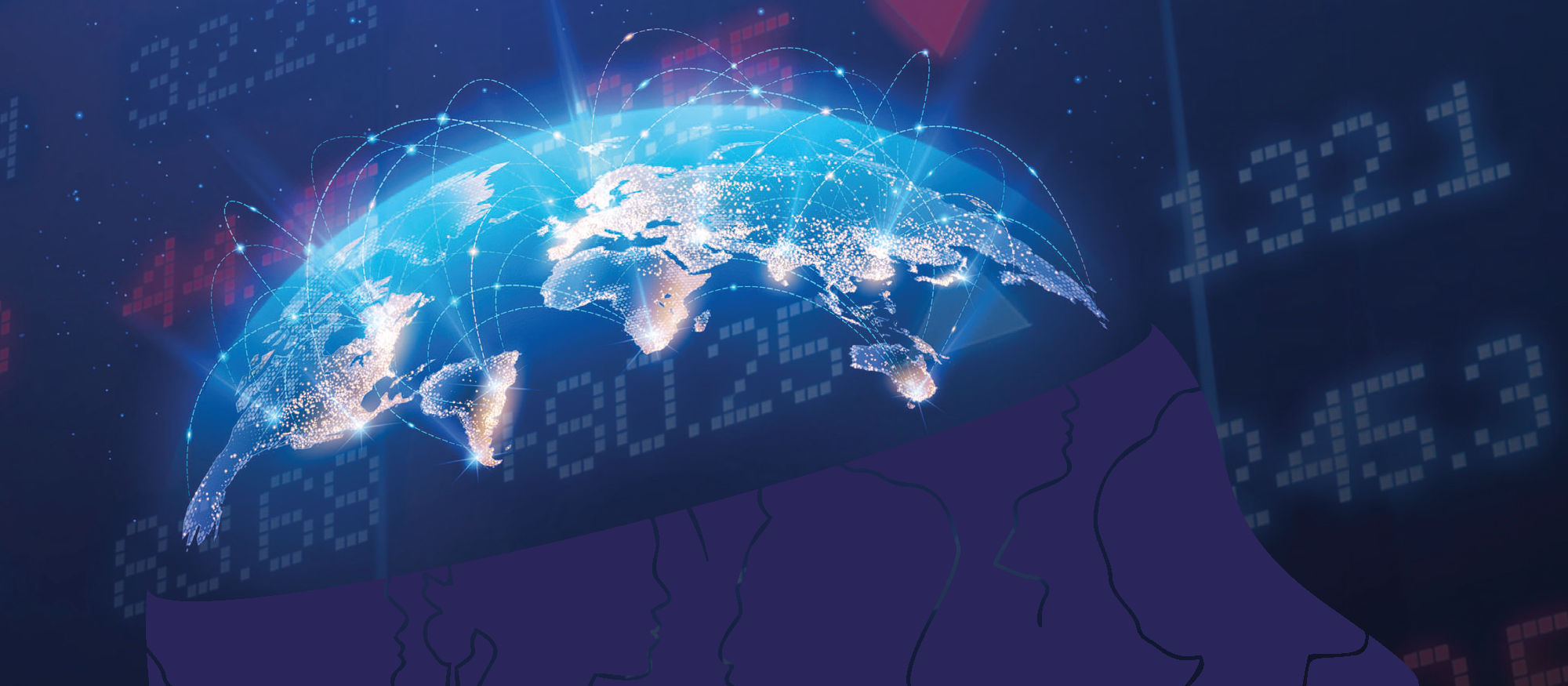
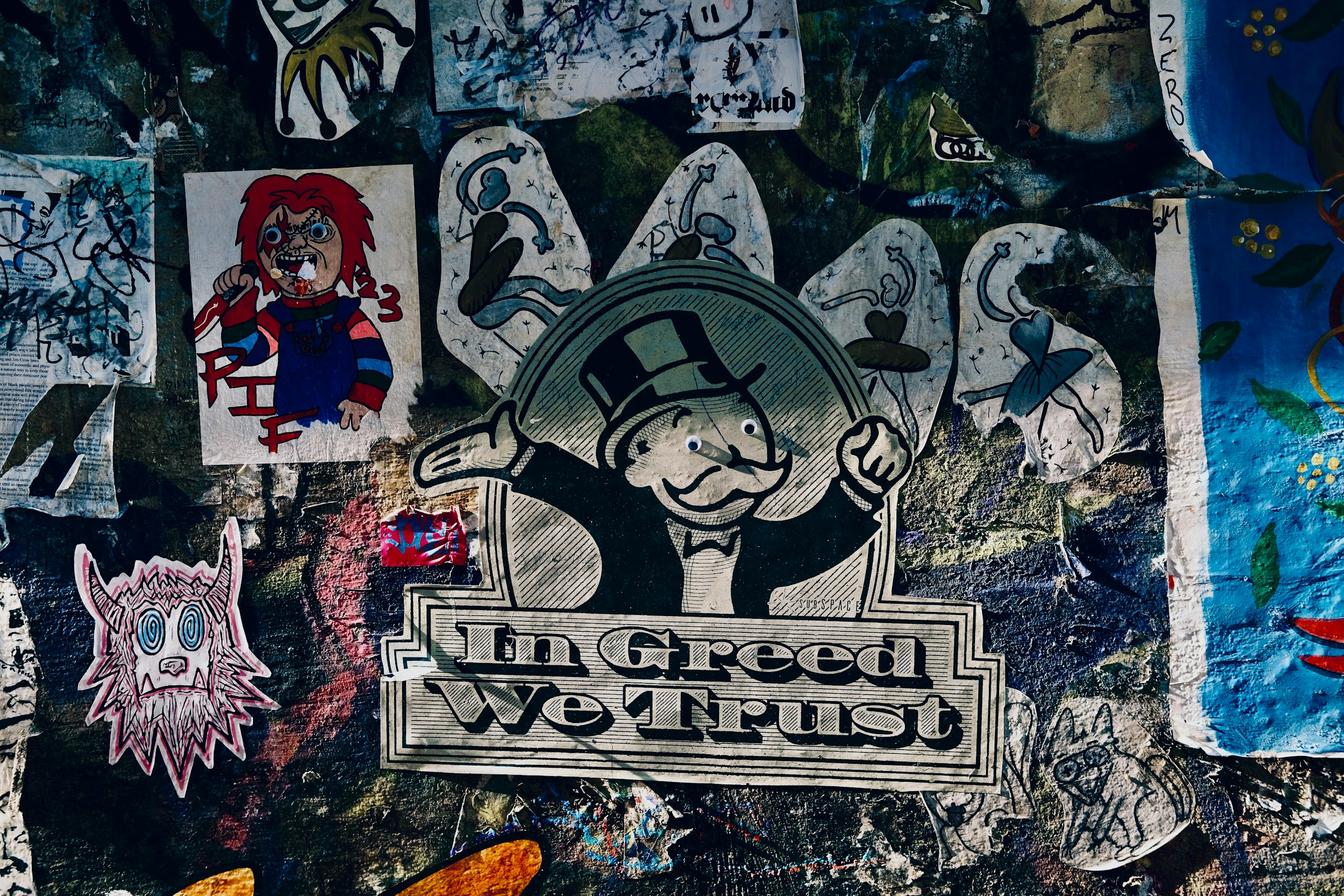
There is a better way, and it is hiding in plain sight. Hidden by our current beliefs.
That’s the stance that has guided our work building a new, regenerative, economic paradigm for the past two decades.
The theologian Dietrich Bonhoeffer wrote shortly before he was executed for opposing Hitler, “We have been made stupid” (Bonhoeffer, 1945). His point was that we lose the capacity to see what is really happening when a set of unsound beliefs is institutionalized. Such beliefs, lacking objective evidence, or even in the presence of contradicting objective evidence, can only be maintained if people have been made stupid.
Here are three examples of such unsound beliefs, which we will unpack in more detail below. Acting according to these unsound beliefs, myths rather than actuality, has profound, harmful consequences for us (Boyd and Reardon, 2020; 2023):
- Myth: randomness averages out over time. Randomness is an unavoidable part of how most things change over time. How much your food supply changes, how a company’s revenue and expenses change, or how your self-esteem changes over time, typically has a random component. There are two different kinds of randomness: either the changes average out over time, i.e., keep going long enough, and the randomness averages out (named ergodic randomness); or they do not average out over time (called non-ergodic randomness). Economics, portfolio theory, and business theory assume that randomness averages.
But almost everything in life, including our economy, has the non-ergodic type of randomness that does not average out. Instead of trending to the average, it trends below average. Which probably sounds wrong to you, because we’re taught that the average is the most likely outcome! But that is only true for the very rare case of ergodic randomness.
Whenever you have compound growth, bankruptcy, or resource constraints, you have non-ergodic randomness. And for these three types of non-ergodic randomness, the most likely outcome is below average. This systemic over-estimation in the economy we call the ergodicity error, caused by the myth that all randomness is ergodic. - Myth: competition is the solution. Nature has demonstrated for four billion years that competition and collaboration can both be simultaneously high; they are a complementary pair, not a polarity. Believing in pure competition as the solution to every problem prevents us from seeing better ways that blend both. And such a blend is the best strategy in a world dominated by non-ergodic randomness!
- Myth: seeing a company as being an ownable thing. In law, a company is a person, with the freedom of any person, human or nonhuman, to enter into a contractual relationship with other persons, such as investors, employees, etc. A share certificate does not give an investor ownership of the company; it’s a contract between two persons defining their rights and obligations, including governance rights, information rights, and financial rights. Only when companies have sufficient agency can they cooperate and compete in the optimum balance to form the ecosystem needed to deal with non-ergodic dynamics.
Only when we emancipate ourselves from the old paradigm and its myths can we see the better ways that can be revealed by the new one.
David Sloan Wilson's article proposes two criteria. Does the paradigm:
- Conform to factual knowledge; and
- Inform appropriate action.
Our assessment is that:
- Far too much of economics and business is an attempt to make nature conform to the mainstream paradigm’s beliefs of how the world ought to be, rather than how the world actually is.
- Despite its unsound grounding, economics has a high impact in informing action, but this is all too often harmful, inappropriate action, precisely because economics is ungrounded in how the universe actually behaves.
In physics, Graham’s original discipline, one pattern has repeated itself so often that every budding physicist learns about it early in their career: whenever well-respected authorities have said something like “we seem now to have understood everything thoroughly, and all that is left is to tidy up the details”, we are on the edge of a paradigm disruption. Such as from Newtonian to relativistic quantum dynamics.
So, the quotation David references from Economics as Universal Science (Heilbroner, 2004, p. 615): “Economics has become the imperial social science…Its formal mode of argument, mathematical apparatus, …” we read as a very clear sign that the old paradigm is long past its sell-by date. And that a new paradigm has begun emerging.
Over the past two decades, Graham, in practice working with investors and business leaders, and Jack, on the economics theory side, have been engaged with Econophysics, i.e., economics that respects the fundamental laws of the universe, including physics, biology, and complex adaptive systems, to get a better paradigm based on actuality as it is.
One key component of this reframing of economics to accord with actuality deals with the first myth above, that all randomness is ergodic over time. This is the rapidly growing field of ergodicity economics (Adamou and Peters, 2025). Two common harmful consequences of non-ergodicity in our economy (and in all of life) are
- Volatility drag (which causes the typical outcome of compound growth to perform worse than the average outcome), and
- Black and white swan events (extreme events, either harmful or beneficial, that are far more likely than standard Gaussian statistics allow for (Taleb, 2007).
Why was non-ergodicity neglected, i.e., the ergodicity error committed, in the early days of developing economics? Because, as David stresses in his opening article, the equations cannot be calculated in closed form. Only in computer simulations.
Once the non-ergodic terms are included in the equations, a number of harmful features of our modern economy are visibly consequences of the ergodicity error (i.e., neglecting the non-ergodic terms).
Two key harmful consequences of this ergodicity error are (Boyd and Reardon, 2023):
- The strategy in venture capital investing, e.g., to bet on the extreme statistical outlier to repay the fund, and
- The belief that pure competition in the marketplace is all you need.
Both of these are harmful, even to the investors, but because the beliefs underpinning Modern Portfolio Theory and much of economics prevent investors from including non-ergodic terms, we cannot see the significantly better strategies available to us.
The better strategy, in order to have a real-world financial capital economy that works for all humans and all life, is to use the same strategy nature has proven to work well in dealing with non-ergodic dynamics: form multi-level adaptive ecosystems, in which the relationships between entities can simultaneously be highly collaborative and highly competitive. (The evidence basis for multi-level selection is steadily growing, see the recent review of Marín, 2026.)
In our economy, such multilevel adaptive ecosystems can only be formed if individual companies have the agency they need to stay in the right relationship with all of the companies, institutions, humans, and all other living beings that they interact with. This requires each company to have the right agency, flexibility, and adaptive capacity found in nature.
Adaptive systems depend on agency to respond appropriately and fast to changes. There are two types of adaptive systems, as described in David’s target essay that we are responding to.
- CAS1 is adaptive as a whole system (e.g., a healthy human being); and
- CAS2 is susceptible to being maladaptive as a whole because the components often act at cross-purposes with each other (think of any large or small corporation, and the company politics).
We can only create the kind of adaptive economic system we need when we fully recognise that agency continues beyond the individual human person to collective persons. In other words, organised and structured groups of human beings, especially when such a group has been recognised in law as a person (i.e., incorporated). We need a multi-level perspective of persons and agency.
From a multilevel perspective, an individual human is to the incorporated entity they’re part of as an individual bee is to the beehive it is part of.
A multi-level perspective sees each company as a whole system, composed of individuals with their own agenda and agency, and the economy as a whole system composed of individual companies with their own agenda and agency. So, to have an adaptive system for the local, regional, and global economy, we need to govern companies so that they have the agency needed to self-organise, coordinate, and together govern the system.
But the belief that a company is a thing, a tool of the investors, and not an agent with agency, dominates our extractive paradigm. And so the economy can only be maladaptive because the very agency needed to be adaptive is removed in practice.
We then attempt to restore adaptive systems capacity through laws, but laws are all too often acting from outside the system instead of emerging from within; at best fail to foster, and often harm, a sense of identity and purpose; and most critically are only passed long after they’re needed. Adaptive capacity needs to be at least as fast as the speed of change and emerges within the system, which requires appropriate agency.
We can already do almost everything needed to get companies to be complex adaptive systems. In law, once incorporated, a company has legal personhood (Kurki, 2019) (the space of agents with the agency to act in accord with relevant rights and obligations), which means that it is not classed in the category of thinghood (the class of things subject to property law). A company in law is an independent person with full agency. It is not owned by the investors (limited company) or the staff (in a co-operative).
So why do we end up treating companies as property of the investors, or of the staff, or of stewards, or whatever? Because the belief that the company is property leads us to govern it in ways that lead to the same outcomes as if it were property! Despite it being a person with agency in law.
- In the standard limited company, one has investor primacy (how much money you’ve invested defines your voting power over the company).
- Or, in the standard co-operative, having an employment contract is the basis for one’s power over the company.
Both restrictions of governance to a single type of human perspective and agenda prevent the company from having the agency and, hence, adaptive capacity it needs.
So long as our current paradigm is the lens through which one sees everything, the best that we are able to imagine are less harmful ways within that paradigm. For example, so long as one is in a paradigm of corporate ownership, the best one comes up with is less harmful ways of owning, such as employee ownership or steward ownership. (Both of these have vital elements, but lack the critical elements of agency needed to be fully viable components of the new paradigm.)
Evolutionary theory must be satisfied in any new paradigm that enables humanity to thrive long term: communities of human beings, whether it’s a traditional tribal unit, a modern suburban city, or a corporation, are higher-level units of natural selection, just as much as the hive is a higher-level unit of natural selection than the individual bee.
None of these “less bad, within the same ownership paradigm” can lead to the new complex adaptive systems paradigms needed to construct an economy that enables all life to thrive. Only incorporation forms based on the minimum requisite patterns of fully adaptive complex systems, especially the pattern of agency, can do so.
The beauty is, we have everything we need in almost all legal jurisdictions to build companies that have the full agency needed to be part of the new economic paradigm we need.
We at Evolutesix, and our partners in the FairShares Association, along with other groups such as that of Norman Wolfe and his The Living Organisation (Wolfe, 2011) approach, have already been using existing legal structures to incorporate companies with full agency. These are being done by making use of the capacity, standard in company law in many jurisdictions, to define multiple classes of shares with different qualifying criteria. This way, multiple stakeholders and capitals are included in governance and wealth share, not just financial investors. Through this pattern of agentic incorporation, a.k.a. FairShares Commons (Boyd and Reardon, 2020), the articles of incorporation include everything needed to protect the company against capture by a narrow interest group. Well over 100 companies have begun this journey (Ridley-Duff, 2020)!
With this new paradigm building block for new capacity for economic systems to be adaptive is opened up.
One example of what this new paradigm enables: it becomes unambiguously clear that precisely because the economy is non-ergodic, we can only have a circular, regenerative, doughnut, etc. economy if the financial layer has circularity in financial capital (Gross, 2026). Believing the old paradigm (which pretends non-ergodicity doesn’t matter) is one root cause of previous attempts to all end up in washing (sustainability washing, ESG washing, etc.)
There’s a final component to the new paradigm that we have been working on, described in the appendix of our book Rebuild (Boyd and Reardon, 2020). Just as Einstein and his peers made the significant breakthrough that led to the relativistic theory when they changed from a paradigm of forces between particles to one based on the geometry of spacetime, perhaps a necessary paradigm shift in economics is to shift from a theory based on economic forces to one based on beliefs about value.
General relativity is captured in an equation: on one side, the way that matter shapes the geometry of space-time; and on the other, the way that the geometry of space-time tells matter how to move.
What might become clearer if we use an equivalent lens for our economy? A lens that doesn’t try to make economic forces cause the dynamics we see in our economy. Instead, analogous to Einstein’s General Relativity, a lens that looks at the beliefs and paradigms that shape our “spacetime of value,” and then this space-time of value causes objects of value to move (from one person to another in trade) and change in value.
In such a relativistic General Theory of Economies, the role of beliefs and the role of paradigms take center stage. It makes clear that it is our belief about gold that leads us to value it, not so much its inherent value.
In short, the lenses we see the world through, our beliefs, our paradigms, and the templates we use to attribute meaning play a central role in formulating our theories. To change our outcomes, we must change our strategy and structures, which means changing our theories, which is only possible if we change our paradigm.
One final thought. Anything, perhaps everything, written in this response, and in this entire volume, may be a spurious artefact of our beliefs! So we need to remain critical. We need to keep in mind that no human being can be the authority on whether or not a theory describes how actuality works. Only actuality itself.
References:
Wilson, D. S. (2026) "On the Concept of Paradigms and a New Paradigm for Evolving Cooperative Systems." And literature cited therein. This View of Life, Jan. 7, 2026.
Adamou, A and Peters, O. (2025) An Introduction to Ergodicity Economics. LML Press
Bonhoeffer, D. (1945; 2010) “After Ten Years,” in Letters and Papers from Prison, ed. John W. de Gruchy. Minneapolis: Fortress Press.
Boyd, G. and Reardon, J. (2020) Rebuild: The Economy, Leadership, and You. Evolutesix Books.
Boyd, G. and Reardon, J. (2023) The Ergodic Investor and Entrepreneur. Evolutesix Books.
Gross, J. A., Blomsma, F., & Boyd, G. (2026). Circular Ecosystems 2.0: The Systems-Change Gap between Resource Circularity and Financial Extraction. Preprint at https://ssrn.com/abstract=6145306 or https://dx.doi.org/10.2139/ssrn.6145306 or https://www.researchgate.net/publication/400153596
Heilbroner, R. (2004). Economics as Universal Science. Social Research: An International Quarterly, 71(3), 615–632.
Kurki, V.A.J., (2019) A Theory of Legal Personhood. Oxford University Press
Marín C. et al, (2026) Abundant empirical evidence of multilevel selection revealed by a bibliometric review, Frontiers in Ecology and Evolution. DOI: 10.3389/fevo.2026.1752597
Ridley-Duff, R. et al. (2020) Creating Social Enterprises in FairShares Labs Independently published
Skinner, B. F. (1981). Selection by Consequences. Science, 213, 501–504.
Taleb, N. N. (2007) The Black Swan, Random House
Wolfe, N. (2011) The Living Organisation. Quantum Leaders Publishing.