%20beskuren.jpg)
After finishing her Ph.D., evolutionary biologist Patricia Brennan1 went to Sheffield to study bird penises. As she dissected her first duck and looked at the long, spiral-shaped penis, she immediately wondered where it went. She asked her advisor what the females looked like, and he answered: “What do you mean? Like every other female, I don’t know.” Brennan incredulously replied, “Oh, they don’t look like every other female. I bet you they have some weird vaginas!” She went back to the farm where she got the male duck, received a female duck, dissected it, and discovered a crazy, elaborate vagina.
The question about the anatomy of vaginas was a question nobody had posed before, despite the fact that people have dissected ducks for a long time, studied their reproduction, conducted artificial insemination, and, in addition, eat ducks. The methodology Brennan used, describing the morphology of organs, is old; it could have been done a hundred years ago. Her discovery is in line with the findings of my collaborators and me that the majority of genital evolution studies focus mainly on male genitals and that this bias persisted over the years. One prerequisite for the discovery of elaborate duck vaginas was, of course, the previous lack of knowledge about female genitalia in general. Biological research, just as medicine, has used the male as a norm and thereby marginalized and hindered the production of knowledge about females. In other words, it has been androcentric, placing the male point of view at the center of its worldview.
This ignorance has to do with the history of science. Certain groups of people, based on gender, class, sexuality, and race, have for a long time been marginalized or excluded from participating in the making of science, and these exclusions influence which questions have been asked, methods used, and interpretations made. Thereby, prevailing assumptions about sex and race have been shielded from critical scrutiny. Therefore, feminists have criticized the widely held view that science is objective and value-neutral. As feminist biologist Ruth Hubbard once wrote, “Science is made by people who live at a specific time in a specific place and whose thought patterns reflect the truths that are accepted by the wider society.” Feminist theoreticians have suggested new theories of knowledge that take the cultural and social aspects of science into account. Science theorist Donna Haraway talks about the impossibility of performing the “god trick of seeing everything from nowhere,” because it is not possible to detach researchers from their social and cultural context. In line with this reasoning, science philosopher Helen Longino argues that social values are inescapable in the content of science and may sometimes have positive influences. Therefore, Haraway suggests a feminist theory of knowledge that recognizes that all knowledges are partial, historically context-bound, and based in lived experiences. Researchers are always part of their cultural and social context, which influences the knowledge produced and also not produced.
Inclusion of people who have previously been excluded from science has repeatedly led to new discoveries and changes in understanding, for example, in primatology and developmental biology. A recent study illustrates that women have contributed to a paradigm shift in birdsong research. Historically, birdsong has been considered something mainly males do, and a prime example of sexual selection by which males keep competitors away and attract females. The last 20 years of research on birdsong have shifted this view, through the discovery of widespread female birdsong occurring among two-thirds of all songbird species. It turns out that women researchers, to a larger degree, have published research on female birdsong, and this newfound knowledge has led to a paradigm shift in our understanding of this field.
A reconstruction of birdsong evolution shows that the ancestral state was that both males and females sing, and therefore, we now need to figure out why female birdsong has been lost in certain bird lineages, rather than why it emerged in males. Furthermore, when it comes to birdsong, species with only male birdsong dominate among the migratory birds in the Northern hemisphere, while female birdsong is more common in the tropics and in Australia. Since most of the bird research has been conducted in the Northern hemisphere, there has been a geographical bias, in addition to gender bias, that has contributed to the ignorance of female birdsong. Ornithologist Jordan Price fantasizes that “if Darwin had grown up in the tropics or if he was Australian, he might have asked why the female birds he saw on his travels in northern climates didn’t sing instead of asking why males have elaborate song.” It is interesting to imagine what research questions would emerge from another perspective.
In my book The Female Turn: How Evolutionary Science Shifted Perceptions About Females, I investigated how evolutionary biologists bit by bit moved away from perceptions of females as coy and passive, towards acknowledging that females can have active sexual strategies, be fiercely aggressive, dominant, and variable among themselves. I wondered who knew and who did not know about active and multiply mating females, and why. I interviewed pioneers suggesting new female-centered hypotheses, highly cited researchers in the field, and feminist researchers. In my interviews, I found both women and men who proposed female-centric hypotheses, investigations, and forwarding the active role of females in sexual selection research. There are many different routes towards changing understandings about females, and perceptions about females shifted at different times in different subfields of evolutionary biology and animal behavior. Important factors that influenced the researchers’ understanding of females were their theoretical perspectives, life experiences, and study species.
For some, feminist insights informed their questioning of the status quo in the prevailing sexual selection theory, engendering new research questions and investigations about female animals. Feminist biologists have been important in forwarding these perspectives and pointing out gender bias in science. In other cases, empirical discoveries of their study species stimulated a female-centric hypothesis about sexual activities. For example, Randy Thornhill studied hanging flies and found that females have active strategies to counteract males that are trying to copulate with them by force. In yet others, knowledge from a different research field, such as pest control studies of insects, brought about insights that females mate with multiple males, contrary to prevailing assumptions that a female only mated with one male. New methodologies provide another route, for example, the use of DNA-fingerprinting enabled the revelation that most female birds mate with more than one partner. Although this pattern of widespread multiple mating by females was initially interpreted as induced by males, so that the perception of passive bird females remained (until some feminist researchers provided evidence that at least in some bird species, females seek out males and initiate matings).
Such androcentrism has repeatedly led researchers to overlook available scientific information about active females, thus producing ignorance. In this history of sexual selection research, I found a repeated pattern of focusing on male-centric explanations or investigations first and followed by female-centric equivalents, exemplifying androcentrism. Undermining the authority of certain knowers is another way in which ignorance has been produced, such as when Western primatologists did not cite Japanese primatologists’ findings of active and dominant females because they considered their methods atheoretical. Furthermore, there is a widely known citation hierarchy within the field in which bird research is considered on top. Everyone cites bird research, while researchers working on other species are less often cited. Imagine if there had not been this citation hierarchy, wouldn’t the perceptions of females have shifted more quickly among the different subfields then?
The role of feminism has not merely been through the work of feminist researchers; feminism has paved the way for women to enter science in large numbers, and it has also changed the roles and views on women in society, which has influenced perceptions about female animals. Also, already in the 1930s, there existed very early natural history accounts of females initiating or readily accepting to mate with other males than their social mate in birds and primates, but these interpretations did not influence the scientific community’s consensus at the time. It was not until after the “second wave” feminist movement, the availability of the pill, and the entrance of many women into science that this multifaceted female turn happened.
All scientists have their own biases forming their partial perspectives – their theoretical frameworks, their human senses, study species, geographical locations, cultures, and experiences. The history of shifting perceptions of females shows that diversity in perspectives, study species, and experiences fosters a scientific community that develops more comprehensive understandings of nature. In philosopher of science Helen Longino’s words, knowledge is produced in “an interactive dialogic community,” and in order to enable progress in scientific knowledge, it is important that research is constructed by an adequately diverse community with an open, critical dialogue and serious consideration of all relevant perspectives. Which fractions of nature become known and which remain unknown is the result of negotiations in society and the scientific community. The sexual selection research field has developed to include perceptions of active, multiply mating and variable females, such as Patricia Brennan's investigations of co-evolving and dynamically developing genitals among ducks.
Notes:
[1] Brennan writes about her studies of genital morphology in this essay series.
[2] Since then, she has become an expert on genitalmorphology in vertebrates and the coevolution between female and male genitals.
[3] Ah-King et al., 2014. See also a follow-up review by Orbach, 2022.
[4] Travis, 1992.
[5] Harding, 1986, Haraway, 1988, Schiebinger, 1989.
[6] Longino, 1990.
[7] Harding, 1986.
[8] Hubbard, 1979: 7.
[9] Haraway, 1988.
[10] Longino, 1990.
[11] Ibid.
[12] Nelson, 2017.
[13] Haines et al. 2020.
[14] Ibid.
[15] Borgmann, 2019.
[16] Ah-King, 2022a.
[17] Ah-King, 2022b.
[18] Ah-King, 2022a.
References:
Ah-King, M. (2022a). The Female Turn – how evolutionary science shifted perceptions about females. Palgrave Macmillan.
Ah-King, M. (2022b). The history of sexual selection research provides insights as to why females are still understudied. Nature Communications 13, 6976. https://doi.org/10.1038/s41467-022-34770-z
Ah-King M., Barron A.B., Herberstein M.E. (2014) Genital Evolution: Why Are Females Still Understudied? PLoS Biol 12(5): e1001851. doi:10.1371/journal.pbio.1001851
Borgmann, K. (2019). The forgotten female: how a generation of women scientists changed our view of evolution. The Living Bird Magazine June 17, 2019. https://www.allaboutbirds.org/news/the-forgotten-female-how-a-generation-of-women-scientists-changed-our-view-of-evolution/
Haines C.D, Rose E.M., Odom K.J., and Omland K.E. (2020). The role of diversity in science: a case study of women advancing female birdsong research. Animal Behaviour; https://www.sciencedirect.com/science/article/abs/pii/S0003347220302256
Harding, S. (1986). The science question in feminism: Industrial policy in Europe. Cornell University Press.
Haraway, D. J. (1988). Situated knowledges: The science question in feminism and the privilege of partial perspectives. Feminist Studies, 14(3), 575–599.
Hubbard, Ruth. (1979) Have only men evolved? In: Hubbard, R., Henifin, M. S. & Fried, B. (eds), Women Look at Biology Looking at Women. G.K. Hall.
Longino, H. E. (1990). Science as social knowledge: Values and objectivity in scientific inquiry. Princeton University Press.
Nelson, L. H. (2017). Biology and feminism: a philosophical introduction. Cambridge University Press.
Orbach, D. N. (2022). Gender bias in the study of genital evolution: females continue to receive less attention than males. Integrative and Comparative Biology 62 (3): 533–541. https://doi.org/10.1093/icb/icac012
Schiebinger, L. (1989). The mind has no sex? Women in the origins of modern science. Harvard University Press.
Schiebinger, L. (1999) Has Feminism Changed Science? Harvard University Press.
Travis, C. (1992). The mismeasure of woman, why women are not the better sex, the inferior sex, or the opposite sex. Touchstone.
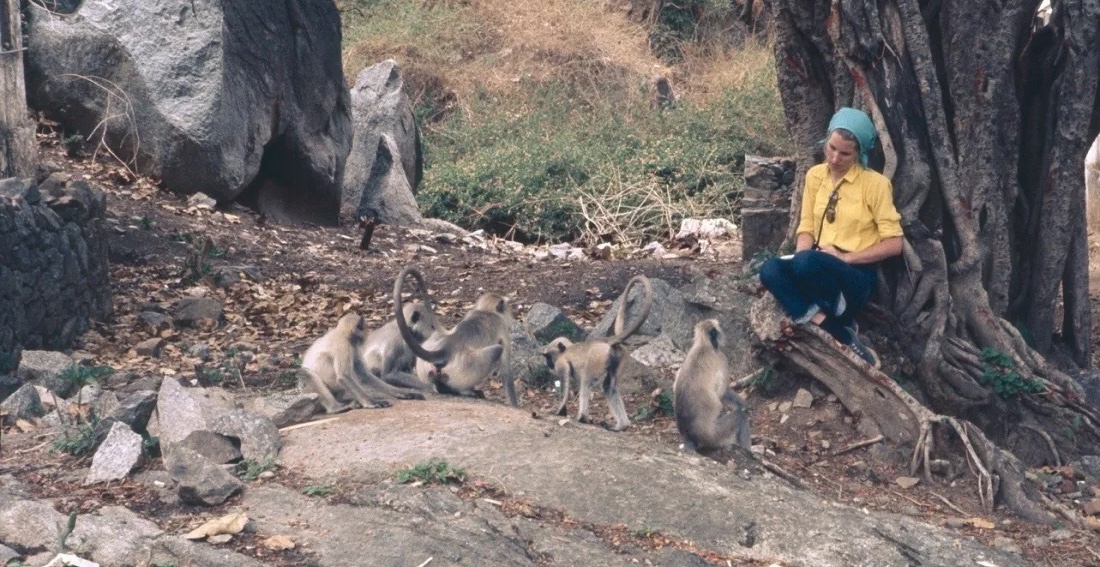
Header Image: Primatologist Sarah Blaffer Hrdy studies the langurs of Abu. Read an interview with her here.